#Structural Equation Modeling R Code
library(lavaan)

data_file_name <- LonelinessData |>
  dplyr::select(
    secure           = Attach1_Secure,
    avoidant         = Attach2_Avoidant,
    anxious          = Attach3_AnxiousAmbivalent,
    dismissing       = Attach4_DismissingAvoidant,
    self_concept     = Total_SelfConcept,
    total_loneliness = Total_Loneliness
  )

model <- '
  self_concept ~ a1*secure + a2*avoidant + a3*anxious + a4*dismissing
  total_loneliness ~ b*self_concept + c1*secure + c2*avoidant +
                     c3*anxious + c4*dismissing
  secure   ~~ avoidant + anxious + dismissing
  avoidant ~~ anxious  + dismissing
  anxious  ~~ dismissing
  indirect_secure     := a1 * b
  indirect_avoidant   := a2 * b
  indirect_anxious    := a3 * b
  indirect_dismissing := a4 * b
'

fit <- sem(model, data = data_file_name, estimator = "MLR", missing = "fiml")
summary(fit, fit.measures = TRUE, standardized = TRUE)Attachment, loneliness, and self-concept: The mediating role of self-concept during the transition to college
Research Brief
Published article: Byrd, N. S., & Robinson, J. R. (2026). Attachment, loneliness, and self-concept: The mediating role of self-concept during the transition to college. Current Psychology, 45, 1356. https://doi.org/10.1007/s12144-026-09887-9
Introduction
Loneliness during the college transition is among the strongest correlates of poor academic performance, mental health difficulties, and early withdrawal from college (Diehl et al. 2018). The first year is a high-risk window because, often for the first time, students leave home, rebuild their social networks, and continue forming a sense of identity at once.
This study examined how attachment style, a relatively stable pattern of relating to others rooted in early caregiving experiences (Bartholomew and Horowitz 1991), relates to loneliness during this period, and whether self-concept accounts for part of that association.
Method
Participants were N = 1,296 U.S. undergraduates (Mage = 24.5, SDage = 8.33) recruited through SONA (n = 575) and Prolific (n = 721) between December 2024 and March 2026. Attachment style was measured with the four-item Relationship Questionnaire (Bartholomew and Horowitz 1991), a dimensional measure of secure, avoidant, anxious/ambivalent, and dismissing-avoidant styles. Loneliness was measured with the six-item De Jong Gierveld scale (Jong Gierveld and Tilburg 2006), which yields emotional and social subscales and a total score. Self-concept was measured with the 20-item Tennessee Self-Concept Scale, Second Edition (Fitts and Warren 1996).
Hypotheses were tested with Pearson correlations and a saturated mediation model estimated in Structural Equation Modeling (SEM) using lavaan in R (Rosseel 2012). The model used robust maximum likelihood, full-information maximum likelihood for missing data, and percentile bootstrap confidence intervals for the indirect effects. Because participants came from two recruitment sources, the model was re-estimated with platform as a covariate; the indirect effects held in direction and significance, indicating they are not an artifact of recruitment source. The data are cross-sectional, so indirect effects are interpreted under an assumed temporal ordering rather than as established causal mediation (Maxwell and Cole 2007).
Results
The structural equation model is shown in Figure 1
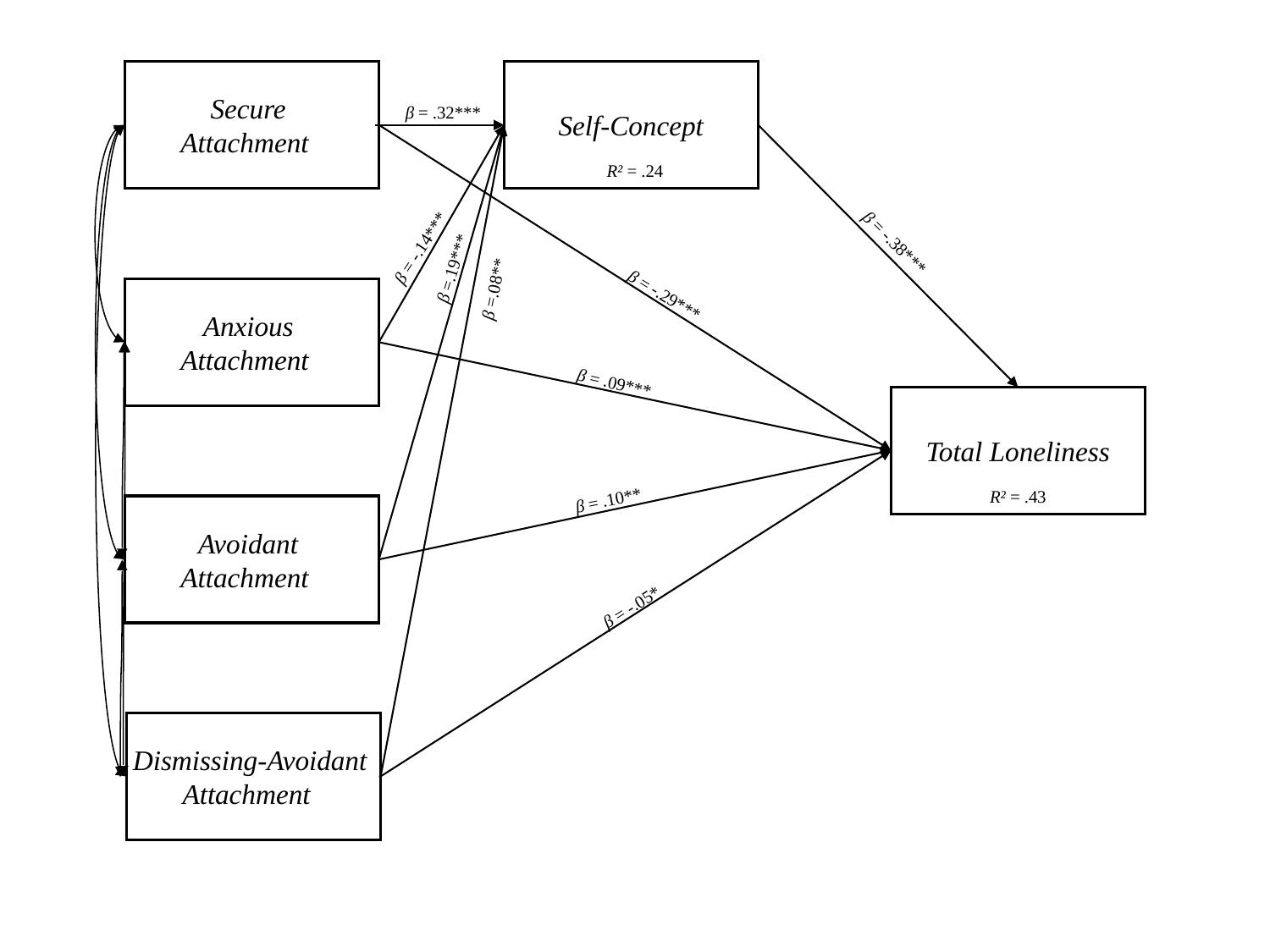
Secure attachment was the strongest correlate of lower loneliness. Secure attachment showed a large negative correlation with total loneliness (r = -.52, p < .001) and the largest protective direct effect in the model (β = -.29, p < .001). Avoidant attachment showed the strongest positive association (r = .43, p < .01), followed by anxious/ambivalent (r = .22, p < .01).
Attachment styles related to both loneliness subtypes, with one exception. In the exploratory subtype analysis, avoidant and anxious/ambivalent attachment correlated positively with both social and emotional loneliness, and secure attachment correlated negatively with both (all p < .001). Dismissing-avoidant attachment correlated with emotional but not social loneliness, consistent with a tendency to suppress relational needs (Benoit and DiTommaso 2020).
Self-concept partially explained the attachment and loneliness association. The path from self-concept to loneliness was negative and significant (β = -.38, p < .001), and the indirect effect through self-concept was significant for all four styles: secure (b = -0.38, 95% CI [-0.49, -0.29]), avoidant (b = 0.21 [0.14, 0.29]), anxious/ambivalent (b = 0.13 [0.07, 0.20]), and dismissing-avoidant (b = -0.09 [-0.15, -0.02]). The model explained 43% of the variance in total loneliness (R² = .43).
Attachment also predicted how students evaluated themselves. The four attachment styles together explained 24% of the variance in self-concept (R² = .24). Relational patterns students bring to college are already associated with how they see themselves at entry.
Discussion
Loneliness in the first year was associated with attachment patterns students carry from earlier relationships, and those patterns related to loneliness partly through self-concept. The practical value of this is that self-concept is more open to change than attachment style (O’Mara et al. 2006), yet it is rarely an explicit target of loneliness programming in higher education (Ellard et al. 2023).
Because the design is cross-sectional, these associations do not establish that attachment or self-concept cause loneliness. They identify candidate targets that longitudinal and intervention studies should test directly.
Recommendations
Table 1 lays out concrete actions for three audiences, building on programs that already work through students’ social experience.
| First-Year Programs | Counseling & Mental Health | Senior Administrators |
|---|---|---|
| Put self-concept and belonging content into orientation. A brief, online social-belonging exercise delivered before college raised first-year completion in a trial of nearly 27,000 students (Walton et al. 2023). | Screen for attachment and loneliness at intake. Students with avoidant or anxious/ambivalent profiles may benefit from early outreach rather than later crisis care. | Treat student loneliness as a retention and wellbeing metric, given its links to persistence (Nicpon et al. 2006) and health (Perez et al. 2022). |
| Offer structured relationship-building groups. The Connection Project, a facilitated small-group program, reduced loneliness and increased belonging in a randomized trial (Costello et al. 2022). | Consider self-concept-focused approaches alongside social skill-building, since self-concept is modifiable (O’Mara et al. 2006) and seldom the explicit target of loneliness programs (Ellard et al. 2023). | Fund longitudinal research on first-year loneliness to further the field. |
| Train resident advisors and mentors to recognize social withdrawal, since many students will not self-identify as lonely. | Watch for dismissing-avoidant students, who may report emotional loneliness while appearing socially self-sufficient and may need proactive outreach. | Support faculty and staff training in recognizing first-year loneliness, since students spend more time with instructors and advisors than with counselors. |
Conclusion
Students arrive at college with established attachment patterns and self-concepts shaped by earlier experience, and these characteristics are associated with how they experience the transition. Together, attachment style and self-concept accounted for 43% of the variance in loneliness. Much of first-year loneliness is tied to measurable individual differences present at entry, which points to the first-year transition as a practical window for support.
References
Bartholomew, Kim, and Leonard M. Horowitz. 1991. “Attachment Styles Among Young Adults: A Test of a Four-Category Model.” Journal of Personality and Social Psychology 61 (2): 226–44. https://doi.org/10.1037/0022-3514.61.2.226.
Benoit, Annabelle, and Enrico DiTommaso. 2020. “Attachment, Loneliness, and Online Perceived Social Support.” Personality and Individual Differences 167: 110230. https://doi.org/10.1016/j.paid.2020.110230.
Byrd, Natalie S., and Jessica R. Robinson. 2026. “Attachment, Loneliness, and Self-Concept: The Mediating Role of Self-Concept During the Transition to College.” Current Psychology 45: 1356. https://doi.org/10.1007/s12144-026-09887-9.
Costello, Meghan A., Alison G. Nagel, Gabrielle L. Hunt, et al. 2022. “Facilitating Connection to Enhance College Student Well-Being: Evaluation of an Experiential Group Program.” American Journal of Community Psychology 70 (3-4): 314–26. https://doi.org/10.1002/ajcp.12601.
Diehl, Katharina, Carolin Jansen, Kristina Ishchanova, and Jennifer Hilger-Kolb. 2018. “Loneliness at Universities: Determinants of Emotional and Social Loneliness Among Students.” International Journal of Environmental Research and Public Health 15 (9): 1865. https://doi.org/10.3390/ijerph15091865.
Ellard, Olivia B., Charlotte Dennison, and Helena Tuomainen. 2023. “Review: Interventions Addressing Loneliness Amongst University Students: A Systematic Review.” Child and Adolescent Mental Health 28 (4): 512–23. https://doi.org/10.1111/camh.12614.
Fitts, William H., and W. L. Warren. 1996. Tennessee Self-Concept Scale Manual. 2nd ed. Western Psychological Services.
Jong Gierveld, Jenny de, and Theo van Tilburg. 2006. “A 6-Item Scale for Overall, Emotional, and Social Loneliness: Confirmatory Tests on Survey Data.” Research on Aging 28 (5): 582–98. https://doi.org/10.1177/0164027506289723.
Maxwell, Scott E., and David A. Cole. 2007. “Bias in Cross-Sectional Analyses of Longitudinal Mediation.” Psychological Methods 12 (1): 23–44. https://doi.org/10.1037/1082-989X.12.1.23.
Murthy, Vivek H. 2023. Our Epidemic of Loneliness and Isolation: The u.s. Surgeon General’s Advisory on the Healing Effects of Social Connection and Community. U.S. Department of Health; Human Services, Office of the Surgeon General.
Nicpon, Megan Foley, Laura Huser, Elva H. Blanks, Sonja Sollenberger, Christie Befort, and Sharon E. Robinson Kurpius. 2006. “The Relationship of Loneliness and Social Support with College Freshmen’s Academic Performance and Persistence.” Journal of College Student Retention: Research, Theory & Practice 8 (3): 345–58. https://doi.org/10.2190/A465-356M-7652-783R.
O’Mara, Alison J., Herbert W. Marsh, Rhonda G. Craven, and Raymond L. Debus. 2006. “Do Self-Concept Interventions Make a Difference? A Synergistic Blend of Construct Validation and Meta-Analysis.” Educational Psychologist 41 (3): 181–206. https://doi.org/10.1207/s15326985ep4103_4.
Perez, Lilian G., Daniel Siconolfi, Wendy M. Troxel, et al. 2022. “Loneliness and Multiple Health Domains: Associations Among Emerging Adults.” Journal of Behavioral Medicine 45 (2): 260–71. https://doi.org/10.1007/s10865-021-00267-1.
Rosseel, Yves. 2012. “Lavaan: An r Package for Structural Equation Modeling.” Journal of Statistical Software 48 (2): 1–36. https://doi.org/10.18637/jss.v048.i02.
Walton, Gregory M., Mary C. Murphy, Christine Logel, David S. Yeager, et al. 2023. “Where and with Whom Does a Brief Social-Belonging Intervention Promote Progress in College?” Science 380 (6644): 499–505. https://doi.org/10.1126/science.ade4420.
Funded in part by the Summer Fellows Research Program at St. John Fisher University and a seed grant from the Center for Human Evolution and Diversity (CHED) at The Pennsylvania State University.
For correspondence: Natalie S. Byrd, nsb5522@psu.edu